 |
| 1 | |
A pure substance always has the same _____ because it is always made up of _____ |
| | A) | properties, the same kind of mixtures |
| | B) | particles, the same kind of mixtures |
| | C) | boiling point, the same kind of mixtures |
| | D) | properties, the same kind of particles |
|
|
|
| 2 | |
Pure substances can be classified into different groups based on whether they can be broken down by a |
| | A) | chemical change |
| | B) | mechanical change |
| | C) | electrical change |
| | D) | heat change |
|
|
|
| 3 | |
What do scientists call a pure substance that cannot be broken down into other pure substances? |
| | A) | A compound |
| | B) | An emulsion |
| | C) | An element |
| | D) | A particle |
|
|
|
| 4 | |
A(n) _________ is a substance that is made from two or more elements that have combined in a chemical change. |
| | A) | compound |
| | B) | emulsion |
| | C) | suspension |
| | D) | particle |
|
|
|
| 5 | |
Each square in the periodic table represents one |
| | A) | compound |
| | B) | element |
| | C) | molecule |
| | D) | mixture |
|
|
|
| 6 | |
A(n) __________ is an explanation scientists develop after completing many experiments. |
| | A) | model |
| | B) | observation |
| | C) | theory |
| | D) | record |
|
|
|
| 7 | |
All matter is made up of small particles called |
| | A) | elements |
| | B) | models |
| | C) | compounds |
| | D) | atoms |
|
|
|
| 8 | |
When two or more atoms link together, a(n) _______ is created. |
| | A) | suspension |
| | B) | molecule |
| | C) | model |
| | D) | emulsion |
|
|
|
| 9 | |
The statement that atoms cannot be created, destroyed or divided into smaller particles is part of |
| | A) | Dalton's Experimental Theory |
| | B) | Dalton's Atomic Experiment |
| | C) | Dalton's Theory of Molecules |
| | D) | Dalton's Atomic Theory |
|
|
|
| 10 | |
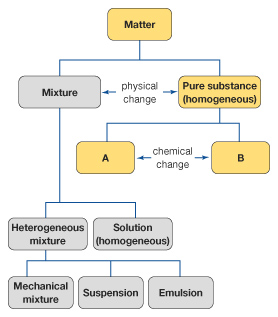 <a onClick="window.open('/olcweb/cgi/pluginpop.cgi?it=jpg::::/sites/dl/free/0070947864/164532/bcscience7_ch5_quiz3_q10.jpg','popWin', 'width=NaN,height=NaN,resizable,scrollbars');" href="#"><img valign="absmiddle" height="16" width="16" border="0" src="/olcweb/styles/shared/linkicons/image.gif"> (51.0K)</a> <a onClick="window.open('/olcweb/cgi/pluginpop.cgi?it=jpg::::/sites/dl/free/0070947864/164532/bcscience7_ch5_quiz3_q10.jpg','popWin', 'width=NaN,height=NaN,resizable,scrollbars');" href="#"><img valign="absmiddle" height="16" width="16" border="0" src="/olcweb/styles/shared/linkicons/image.gif"> (51.0K)</a>
Which of the following two terms best represent (A) and (B) on this chart? |
| | A) | (A) element, and (B) compound |
| | B) | (A) element, and (B) mixture |
| | C) | (A) element, and (B) molecule |
| | D) | (A) element, and (B) property |
|
|
 .
.