 |
1 | |
In this symbolic representation, the arrow points to what type of unit in the backbone of DNA?
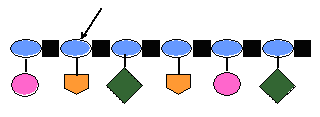 <a onClick="window.open('/olcweb/cgi/pluginpop.cgi?it=gif::::/sites/dl/free/0072410159/51626/12A1.gif','popWin', 'width=NaN,height=NaN,resizable,scrollbars');" href="#"><img valign="absmiddle" height="16" width="16" border="0" src="/olcweb/styles/shared/linkicons/image.gif"> (1.0K)</a> <a onClick="window.open('/olcweb/cgi/pluginpop.cgi?it=gif::::/sites/dl/free/0072410159/51626/12A1.gif','popWin', 'width=NaN,height=NaN,resizable,scrollbars');" href="#"><img valign="absmiddle" height="16" width="16" border="0" src="/olcweb/styles/shared/linkicons/image.gif"> (1.0K)</a>
|
| | A) | nitrogeneous base |
| | B) | phosphate group |
| | C) | monosaccharide |
| | D) | nucleotide |
|
|
2 | |
Determining the X-ray diffraction pattern of DNA was an essential experimental step that led to the determination of the double-helix structure of DNA. Who carried out those experiments first? |
| | A) | Erwin Chargaff |
| | B) | Frances Crick |
| | C) | James Watson |
| | D) | Rosalind Franklin |
|
|
3 | |
A nucleotide is a combination of |
| | A) | several nucleosides polymerized into a larger unit. |
| | B) | a monosaccharide, a phosphate group, and a nitrogen-containing base. |
| | C) | a phosphate group and a nitrogen-containing base. |
| | D) | a monosaccharide and a phosphate group. |
|
|
4 | |
Complementary base pairs on the DNA double helix are held together with |
| | A) | ionic bonds. |
| | B) | covalent bonds. |
| | C) | peptide bonds. |
| | D) | hydrogen bonds. |
|
|
5 | |
On April 15, 2003, it was announced that the Human Genome Project was completed. What was the major goal of the project? |
| | A) | to clone humans |
| | B) | to discover the base pairing in DNA |
| | C) | to find a genetically engineered cure for cancer |
| | D) | to map all of the genes in the human organism |
|
|
6 | |
Which statement about codons is correct? |
| | A) | A codon is a sequence of three nitrogen-containing bases in a DNA molecule that encodes for a specific amino acid during protein synthesis. |
| | B) | A codon is a single-stranded nucleotide that brackets and identifies a segment of DNA to be copied in the polymerase chain reaction. |
| | C) | A codon is a combination of 10 to 10,000 units, each containing a nitrogen-containing base, a sugar, and a phosphate group. |
| | D) | A codon is the name given to the one-on-one correspondence between nitrogen-containing bases in DNA and the essential amino acids. |
|
|
7 | |
At this time, what group bears the burden, and the cost, of most of the safety tests needed before introducing genetically modified (GM) crops into the U.S. food supply? |
| | A) | universities studying GM crops and foods |
| | B) | corporations producing foods from GM crops |
| | C) | U.S. government agencies regulating GM foods |
| | D) | international organizations, such as the World Health Organization |
|
|
8 | |
Which structure of a protein determines the overall shape, or conformation, of the molecule? |
| | A) | primary structure |
| | B) | secondary structure |
| | C) | tertiary structure |
| | D) | quanternary structure |
|
|
9 | |
Which statement about transgenic (genetically-engineered) crops is correct during 2003? |
| | A) | There are no transgenic crops planted anywhere in the world. |
| | B) | Transgenic crops are planted in the U.S. and Canada, but nowhere else in the world. |
| | C) | The U.S. is the only country in the world planting transgenic crops. |
| | D) | At least five countries of the world, including the U.S., plant transgenic crops. |
|
|
10 | |
The term recombinant DNA refers to DNA that has |
| | A) | formed a grouping of three DNA bases. |
| | B) | had its sequence of amino acids identified. |
| | C) | incorporated DNA from another organism into its own DNA. |
| | D) | separated into two strands, but then has recombined into the double helix. |
|
|
11 | |
The human gene for insulin can be inserted into the plasmid rings of bacteria by enzymes. The inter-species DNA is then reintroduced into the bacteria and replicates, increasing the supply of insulin for diabetics. This example illustrates the process of |
| | A) | using recombinant DNA techniques. |
| | B) | cloning of insulin bacteria. |
| | C) | using the polymerase chain reaction. |
| | D) | DNA fingerprinting. |
|
|
12 | |
In 1940, females had a longer life expectancy than males. Which statement best reflects life expectancy in the United States today? |
| | A) | Females still have a longer life expectancy than males. The years that both females and males are expected to live are about the same now as they were in 1940. |
| | B) | Females still have a longer life expectancy than males. Both females and males are not expected to live as long now as they did in 1940. |
| | C) | Females still have a longer life expectancy than males. Both values have been steadily rising since 1940. |
| | D) | Males now have a longer life expectancy than females. Both values have been steadily rising from 1940 to present. |
|
|
13 | |
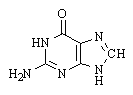
This structure represents guanine, one of the nitrogen-containing bases found in DNA. What is its molecular formula?
 <a onClick="window.open('/olcweb/cgi/pluginpop.cgi?it=gif::::/sites/dl/free/0072410159/51626/12A13.gif','popWin', 'width=NaN,height=NaN,resizable,scrollbars');" href="#"><img valign="absmiddle" height="16" width="16" border="0" src="/olcweb/styles/shared/linkicons/image.gif"> (0.0K)</a> <a onClick="window.open('/olcweb/cgi/pluginpop.cgi?it=gif::::/sites/dl/free/0072410159/51626/12A13.gif','popWin', 'width=NaN,height=NaN,resizable,scrollbars');" href="#"><img valign="absmiddle" height="16" width="16" border="0" src="/olcweb/styles/shared/linkicons/image.gif"> (0.0K)</a>
|
| | A) | CH5N5O |
| | B) | C3H7N5O |
| | C) | C5H5N5O |
| | D) | C5H7N5O |
|
|
14 | |
Genetic engineering techniques have been successfully used for which of these purposes?
I. diagnosis of genetic disease
II. development of drought-resistant plants
III. development of new drugs
IV. identifying human remains |
| | A) | I and III only |
| | B) | II and IV only |
| | C) | I, II, and IV only |
| | D) | I, II, III, and IV |
|