 |
| 1 | |
Traits showing non-Mendelian extranuclear inheritance are always inherited from the mother. |
| | A) | True. |
| | B) | False. |
|
|
|
| 2 | |
The molecules used to carry out photosynthesis are encoded in nuclear DNA and mitochondrial DNA. |
| | A) | True. |
| | B) | False. |
|
|
|
| 3 | |
A chloroplast URF is a cpDNA coding sequence with a product of unknown function. |
| | A) | True. |
| | B) | False. |
|
|
|
| 4 | |
Molecular evidence suggests that DNA sequences may have been transferred between mtDNA and nuclear DNA. |
| | A) | True. |
| | B) | False. |
|
|
|
| 5 | |
Variegated four o'clock leaves have white patches among the green areas due to a mtDNA mutation that blocks electron transport. |
| | A) | True. |
| | B) | False. |
|
|
|
| 6 | |
Mitochondrial inheritance shows Mendel's principle of independent assortment. |
| | A) | True. |
| | B) | False. |
|
|
|
| 7 | |
Mitochondrial genomes are relatively uniform in size. |
| | A) | True. |
| | B) | False. |
|
|
|
| 8 | |
The codon UGA specifies 'stop' in all compartments of a human cell. |
| | A) | True. |
| | B) | False. |
|
|
|
| 9 | |
The gene gun is a tool for incorporating foreign DNA into organelles. |
| | A) | True. |
| | B) | False. |
|
|
|
| 10 | |
The Trypanosoma kinetoplast is the site of RNA editing. |
| | A) | True. |
| | B) | False. |
|
|
|
| 11 | |
__________ is organized into nucleosomes.
|
| | A) | mtDNA |
| | B) | kDNA |
| | C) | nDNA |
| | D) | cpDNA |
| | E) | tRNA |
|
|
|
| 12 | |
__________ encoded by organelles may recognize codons differently.
|
| | A) | mtDNA |
| | B) | kDNA |
| | C) | nDNA |
| | D) | cpDNA |
| | E) | tRNA |
|
|
|
| 13 | |
__________ is composed of maxicircles and minicircles.
|
| | A) | mtDNA |
| | B) | kDNA |
| | C) | nDNA |
| | D) | cpDNA |
| | E) | tRNA |
|
|
|
| 14 | |
__________ is probably derived from a relative of purple non-sulfur bacteria.
|
| | A) | mtDNA |
| | B) | kDNA |
| | C) | nDNA |
| | D) | cpDNA |
| | E) | tRNA |
|
|
|
| 15 | |
___________ is probably derived from an ancestral cyanobacterium.
|
| | A) | mtDNA |
| | B) | kDNA |
| | C) | nDNA |
| | D) | cpDNA |
| | E) | tRNA |
|
|
|
| 16 | |
Organellar genomes derived from only one gamete show a _________ pattern of inheritance.
|
| | A) | homoplasmic |
| | B) | heteroplasmic |
| | C) | uniparental |
| | D) | biparental |
| | E) | isogamous |
|
|
|
| 17 | |
A cell with nonidentical mitochondrial genomes is said to be:
|
| | A) | homoplasmic |
| | B) | heteroplasmic |
| | C) | uniparental |
| | D) | biparental |
| | E) | isogamous |
|
|
|
| 18 | |
Organellar genomes derived from both gametes show a _________ pattern of inheritance.
|
| | A) | homoplasmic |
| | B) | heteroplasmic |
| | C) | uniparental |
| | D) | biparental |
| | E) | isogamous |
|
|
|
| 19 | |
A cell with chloroplast genomes which are identical is said to be:
|
| | A) | homoplasmic |
| | B) | heteroplasmic |
| | C) | uniparental |
| | D) | biparental |
| | E) | isogamous |
|
|
|
| 20 | |
An organism that produces mating cells of the same size is said to be:
|
| | A) | homoplasmic |
| | B) | heteroplasmic |
| | C) | uniparental |
| | D) | biparental |
| | E) | isogamous |
|
|
|
| 21 | |
With traits showing biparental inheritance, such as leaf variegation in geraniums, reciprocal crosses usually:
|
| | A) | yield the same results. |
| | B) | yield different results. |
| | C) | yield result which can seldom be predicted |
| | D) | yield exactly opposite results |
| | E) | none of the above |
|
|
|
| 22 | |
In the study of eukaryotes, DNA-specific dyes and light microscopy reveal DNA molecules:
|
| | A) | in the cell wall |
| | B) | in the matrix of the mitochondrion |
| | C) | in the cytoplasm |
| | D) | in ribosomes |
| | E) | in all of these sites |
|
|
|
| 23 | |
Which process(es) take place in the mitochondrion?
|
| | A) | Krebs cycle |
| | B) | Calvin cycle |
| | C) | photosynthesis |
| | D) | a & b |
| | E) | b & c |
|
|
|
| 24 | |
Mitochondria resemble bacteria in terms of:
|
| | A) | ribosomal genes |
| | B) | size |
| | C) | replication |
| | D) | circular chromosome |
| | E) | all of the above |
|
|
|
| 25 | |
Inhibitors of bacterial translation generally:
|
| | A) | inhibit eukaryotic cytoplasmic protein synthesis |
| | B) | inhibit mitochondrial protein synthesis |
| | C) | inhibit chloroplast protein synthesis |
| | D) | have no effect on eukaryotic cells |
| | E) | b and c |
|
|
|
| 26 | |
Which of the following is true of organelles?
|
| | A) | DNA organized into nucleosomes by histones |
| | B) | translation is not inhibited by bacterial antibiotics |
| | C) | N-formyl methionine and tRNAfmet used in translation. |
| | D) | all of the above |
| | E) | none of the above |
|
|
|
| 27 | |
Which sequences would be most similar?
|
| | A) | mtDNA in mitochondrial Eve and modern human mtDNA |
| | B) | Neanderthal mtDNA and Cro-Magnon mtDNA |
| | C) | mtDNA from the 5,000-year-old 'ice man' and modern human mtDNA |
| | D) | Chimpanzee mtDNA and modern human mtDNA |
| | E) | modern human mtDNA and bacterial DNA |
|
|
|
| 28 | |
Which are the least related in terms of human mtDNA sequence?
|
| | A) | father and daughter |
| | B) | mother and son |
| | C) | nephew and maternal aunt |
| | D) | niece and maternal uncle |
| | E) | grandchild and maternal grandmother |
|
|
|
| 29 | |
A cross is conducted between isogamous algae that show uniparental inheritance where mtDNA is inherited from one parent and cpDNA is inherited from the other. A mutation in cpDNA causes a yellow color, and a mutation in mtDNA confers chloramphenicol resistanc From the following mating:
| yellow/chloramphenicol resistant | x | green/chloramphenicol sensitive |
Which of the following ratios might be observed in the resulting haploid progeny?
|
| | A) | 2 yellow/resistant, 2 yellow/sensitive |
| | B) | 2 green/resistant, 2 green/sensitive |
| | C) | 4 green/sensitive |
| | D) | 4 green/resistant |
| | E) | 1 yellow/resistant, 1 yellow/sensitive, 1 green/resistant, 1 green/sensitive |
|
|
|
| 30 | |
A cross is performed between cells of two genetically different yeast strains, and a long period of vegetative growth of the resultant diploid cells ensues. What is true of the marker genes?
|
| | A) | mitochondrial markers segregate, nuclear markers do not |
| | B) | nuclear markers segregate, mitochondrial markers do not |
| | C) | both mitochondrial and nuclear markers segregate |
| | D) | mitochondrial and nuclear markers from only one parent are observed |
| | E) | neither nuclear nor mitochondrial markers segregate |
|
|
|
| 31 | |
Variable expression of the MERRF syndrome arises from:
|
| | A) | recombination between nuclear and mtDNA |
| | B) | homoplasmic cells |
| | C) | mitotic segregation |
| | D) | nuclear genes |
| | E) | environmental factors |
|
|
|
| 32 | |
What mode of inheritance is suggested by the following pedigree?
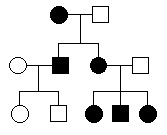 <a onClick="window.open('/olcweb/cgi/pluginpop.cgi?it=gif:: ::/sites/dl/free/0072919302/56745/chap15mc_1.gif','popWin', 'width=NaN,height=NaN,resizable,scrollbars');" href="#"><img valign="absmiddle" height="16" width="16" border="0" src="/olcweb/styles/shared/linkicons/image.gif"> (6.0K)</a> <a onClick="window.open('/olcweb/cgi/pluginpop.cgi?it=gif:: ::/sites/dl/free/0072919302/56745/chap15mc_1.gif','popWin', 'width=NaN,height=NaN,resizable,scrollbars');" href="#"><img valign="absmiddle" height="16" width="16" border="0" src="/olcweb/styles/shared/linkicons/image.gif"> (6.0K)</a>
|
| | A) | biparental |
| | B) | uniparental; maternal |
| | C) | uniparental; paternal |
| | D) | X-linked recessive |
| | E) | Y-linked |
|
|
|
| 33 | |
A form of male sterility in corn exhibits non-Mendelian inheritance. Plants of a male-sterile line crossed with pollen from a wild-type (not sterile) line give all male-sterile plants. Some lines of corn carry a dominant allele of a different, nuclear gene. This "restorer" (or Rf) allele restores pollen fertility in male-sterile lines. If a male-sterile plant is crossed with pollen from a plant homozygous for Rf, what will be the genotype and phenotype of the F1? Cytoplasmic genotype is indicated by [ ], male-sterile cytoplasm is indicated by "ms", and normal cytoplasm is indicated by "n".
|
| | A) | rf/rf [ms]; male-sterile |
| | B) | Rf/Rf [ms]; fertile |
| | C) | Rf/rf [n]; fertile |
| | D) | Rf/rf [ms]; fertile |
| | E) | Rf/rf [ms]; male-sterile |
|
|
 .
.