 |
| 1 | |
Living standards in ancient Rome remained relatively constant for 1000 years because: |
| | A) | population increased at approximately the same rate as output, leaving output per person unchanged |
| | B) | average family sizes increased at the same rate as output per person |
| | C) | constant wars reduced the size of the population at the same rate as output was falling, leaving output per person unchanged |
| | D) | constant wars depleted the economy's capital stock, resulting in little or no growth of total output |
|
|
|
| 2 | |
Compared to the beginning of the Industrial Revolution, living standards around the world: |
| | A) | have approximately tripled for both rich and poor countries, leaving the relative gap between rich and poor countries the same |
| | B) | have grown fastest in what were then the poorest countries, resulting in much less variation between rich and poor nations |
| | C) | show considerably more variation between rich and poor countries |
| | D) | show no marked trend regarding the gap between rich and poor countries |
|
|
|
| 3 | |
The purchase of corporate stock is considered: |
| | A) | an economic investment |
| | B) | a financial investment |
| | C) | dissaving |
| | D) | the same as the purchase of new plant and equipment |
|
|
|
| 4 | |
If all prices could quickly adjust to unexpected changes in demand: |
| | A) | output would fluctuate in inverse proportion to the price changes |
| | B) | output would remain constant and resources remain fully employed |
| | C) | output would fluctuate in direct proportion to the price changes |
| | D) | output would fluctuate in inverse proportion to changes in employment |
|
|
|
| 5 | |
If prices are inflexible, an unexpected reduction in demand for a firm's product would result in: |
| | A) | rising inventories followed by cuts in production |
| | B) | falling inventories followed by cuts in production |
| | C) | immediate cuts in both production and desired inventory levels |
| | D) | rising inventories followed by increased employment of resources |
|
|
|
| 6 | |
Refer to the following diagram:
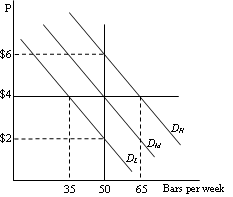 <a onClick="window.open('/olcweb/cgi/pluginpop.cgi?it=gif::::/sites/dl/free/0073375691/627581/q_06.gif','popWin', 'width=NaN,height=NaN,resizable,scrollbars');" href="#"><img valign="absmiddle" height="16" width="16" border="0" src="/olcweb/styles/shared/linkicons/image.gif"> (2.0K)</a> <a onClick="window.open('/olcweb/cgi/pluginpop.cgi?it=gif::::/sites/dl/free/0073375691/627581/q_06.gif','popWin', 'width=NaN,height=NaN,resizable,scrollbars');" href="#"><img valign="absmiddle" height="16" width="16" border="0" src="/olcweb/styles/shared/linkicons/image.gif"> (2.0K)</a>
Suppose a factory minimizes its average costs by producing 50 metal bars per week. It can produce this output profitably at an expected price of $4 each, corresponding to expected demand of DM. With flexible prices, which of the following is the most likely initial consequence of a change in demand? |
| | A) | Production will drop to 35 bars per week if demand unexpectedly falls to DL |
| | B) | Production will rise to 65 bars per week if demand predictably rises to DH |
| | C) | Profits will rise if demand unexpectedly rises to DH |
| | D) | The price will rise to $6 and production will rise to 65 bars per week if demand unexpectedly rises to DH |
|
|
|
| 7 | |
Which product would most likely be characterized by "sticky" prices? |
| | A) | Feed corn |
| | B) | Oil |
| | C) | Natural gas |
| | D) | Magazines |
|
|
|
| 8 | |
The economy tends to exhibit short-run output fluctuations and long-run stability because: |
| | A) | prices are more flexible in the short run than the long run |
| | B) | prices are more flexible in the long run than the short run |
| | C) | demand shocks are more common in the short run while supply shocks are more common in the long run |
| | D) | government and central bank policies are destabilizing in the short run but effective in the long run |
|
|
|
| 9 | |
An unexpected drop in consumer spending would be classified as a: |
| | A) | negative demand shock |
| | B) | negative supply shock |
| | C) | positive demand shock |
| | D) | positive supply shock |
|
|
|
| 10 | |
Refer to the following diagram:
<a onClick="window.open('/olcweb/cgi/pluginpop.cgi?it=gif::::/sites/dl/free/0073375691/627581/q_06.gif','popWin', 'width=NaN,height=NaN,resizable,scrollbars');" href="#"><img valign="absmiddle" height="16" width="16" border="0" src="/olcweb/styles/shared/linkicons/image.gif"> (2.0K)</a>
Suppose a factory minimizes its average costs by producing 50 metal bars per week. It can produce this output profitably at an expected price of $4 each, corresponding to expected demand of DM. Production will likely fall to 35 bars per week if: |
| | A) | prices are flexible and demand unexpectedly falls to DL |
| | B) | prices are inflexible and demand unexpectedly falls to DL |
| | C) | prices are flexible and demand predictably falls to DL |
| | D) | the price unexpectedly falls to $2 |
|
|
 .
.